
WELCOME BONUS 300%
UP TO €2000 + 100
FREE SPINS
UP TO €2000 + 100
FREE SPINS
Home → Blackjack
Blackjack at No Mini: Variants, Rules and Payouts
Error insurance: 7 percent additional house edge
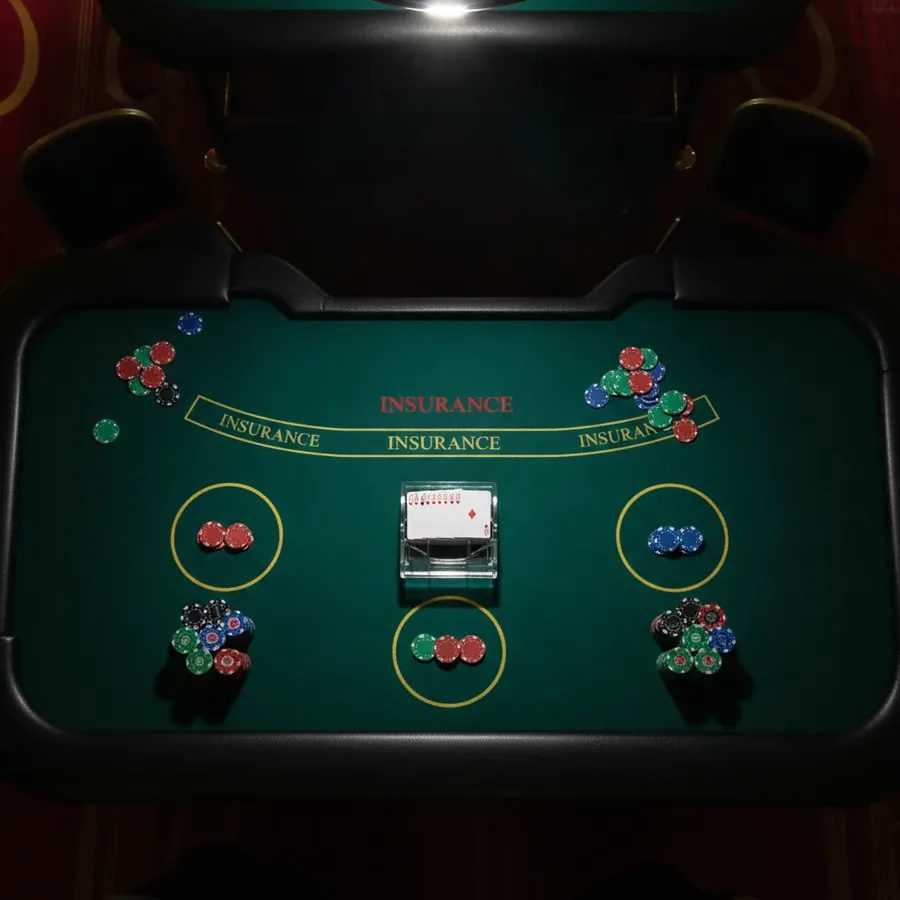
Blackjack Insurance / Versicherung (6–8 Decks) offers a side bet paying 2:1 when the dealer shows an Ace. This wager carries a house edge of 7.47% and an RTP of 92.53%, making it one of the worst bets in the game. The rule dictates that basic strategy always requires rejecting this option unless counting cards with a True Count ≥ +3.
Compared to the standard blackjack payout, this side bet drains bankroll significantly faster due to its high house advantage. For instance, betting 50% of the main stake on insurance exposes the player to losses at a rate nearly 17 times higher than the base game's edge. The separate nature of this bet means it does not improve overall returns but rather acts as a costly hedge.
This high cost explains why the table games contribution to bonus turnover is capped at only 10%. Players using the welcome bonus should avoid this side bet entirely to preserve their balance. The negative expected value over time ensures that consistent use leads to rapid depletion of funds.
Double Down after Split: which tables allow it
Blackjack Liberal Vegas Strip features liberal rules including Double After Split (DAS), contributing to a low house edge of 0.28%. This rule allows players to double their bet on any two-card hand after splitting, improving the RTP by approximately 0.14 percentage points. Such flexibility is crucial for maximizing returns in favorable conditions.
In contrast, Blackjack 6 Decks, S17, DAS, DOA explicitly permits doubling after split, supporting a house edge of 0.46%. This specific configuration includes standing on Soft 17 and resplitting aces, creating a highly player-friendly environment. The combination of these rules ensures that strategic decisions remain optimal throughout the hand.
Conversely, Blackjack Surrender (Late Surrender) lacks explicit mention of DAS, focusing instead on the late surrender rule. While surrender improves RTP by about 0.08 percentage points, the absence of confirmed DAS limits doubling opportunities post-split. Players must verify table specifics before relying on this advanced strategy during bonus play.
Perfect Pairs vs 21+3 in House Edge
Quantum Blackjack Plus Live from Playtech introduces Quantum Multipliers up to 1,000x on three-card combinations, altering traditional paytables. This variant boasts an RTP of 99.57% when played with optimal strategy, significantly higher than standard live dealer games. The inclusion of multipliers adds volatility but maintains a strong theoretical return for skilled players.
Lightning Blackjack by Evolution offers Lightning Multipliers up to 25x on winning hands, providing an RTP of 99.56%. Unlike Quantum versions, these multipliers are applied to final hand outcomes rather than specific card combos. This structure rewards successful predictions while keeping the core game mechanics familiar to regular blackjack enthusiasts.
Standard table games contribute only 10% toward the wagering requirements of the 300% welcome bonus up to €2,000. This low contribution rate discourages heavy reliance on these titles for clearing bonuses compared to slots. Players seeking faster clearance might prefer high-contributing games, though the superior RTP of these live tables remains attractive for long-term play.
What Push Means: Stake Returns to You
Blackjack 6 Decks, S17, DAS, DOA pays normal wins at 1:1, meaning a push results in the full stake being returned. This outcome occurs when both player and dealer have equal totals, preventing any loss or gain on the primary bet. The clarity of this rule ensures transparent expectations for every hand dealt.
Insurance payouts follow a 2:1 ratio, distinct from the main game's push mechanics where no money changes hands. If the dealer has blackjack, insured bets win while the main bet pushes, effectively neutralizing the loss. This interaction highlights the complex risk management available through side wagers.
The 300% welcome bonus up to €2,000 plus 100 free spins requires meeting wagering conditions before withdrawal. Since pushes do not count as losses or wins, they do not directly impact the turnover requirement progress. Players must continue betting active stakes to clear the bonus, as idle hands yield no advancement toward the goal.
Split, Double Down, and Surrender in Numbers
Blackjack Surrender (Late Surrender) allows players to forfeit half their bet after checking for dealer blackjack, improving RTP by ~0.08%. This rule provides a safety net against strong dealer upcards, reducing potential losses over many hands. Early surrender, though rarer and more valuable (up to -0.6%), is rarely found in modern online casinos.
Splitting allows up to four hands, while doubling doubles the initial stake on a single card, expanding strategic options. Resplitting aces further enhances these capabilities, improving RTP by 0.08 percentage points in liberal variants. These mechanical freedoms are essential for minimizing the house edge below 1% in favorable setups.
Blackjack Auszahlung 6:5 instead of 3:2 increases the house edge by exactly +1.39 percentage points, severely impacting profitability. A $10 bet yields $12 instead of $15 on a natural blackjack, drastically reducing long-term returns. This rule change outweighs most other modifications, making 6:5 tables undesirable for serious players despite lower minimum bets.
Blackjack variants at a glance
| Variant | Payout | House edge | Rule | Bet range |
|---|---|---|---|---|
| Blackjack Auszahlung 6:5 statt 3:2 (6 Decks) | 98.15% | 1.85% | Ersatz von 3:2 durch 6:5 fügt exakt +1.39 Prozentpunkte zum Vorteil des Casinos hinzu – stärker als jede andere Regeländerung. Bei $10 Einsatz zahlt Blackjack $12 statt $15. | Blackjack 6:5, Gewinn 1:1 |
| Blackjack 6 Decks, S17, DAS, DOA, Auszahlung 3:2, Basisstrategie | 99.54% | 0.46% | Dealer steht auf Soft 17; Verdopplung auf jeder Zweierkarte; Verdopplung nach Split erlaubt; keine Aufgabe. Basisstrategie ist für diesen Wert zwingend | Blackjack 3:2, normaler Gewinn 1:1, Insurance 2:1 |
| Blackjack Split / Double / H17 – Regel-Effekte | n.a. (Regel-Modifikatoren) | H17 +0.22 Prozentpunkte; RSA −0.08 Prozentpunkte; DAS −0.14 Prozentpunkte | Dealer Hits Soft 17 verschlechtert RTP um 0.22 Prozentpunkte; Resplit Aces verbessert um 0.08 Prozentpunkte; Double After Split verbessert um ca. 0.14 Prozentpunkte; 6 Decks statt 8 – ca. 0.02 Prozentpunkte. | Double – Einsatz ×2 mit einer Karte; Split – bis 4 Hände; Ass-Split meist mit einer Karte. |
| Blackjack Liberal Vegas Strip (liberale Regeln, 3:2) | 99.72% | 0.28% | Günstigste Regelkombination: S17 + DAS + Resplit + Late Surrender. Standardabweichung 1,15 | Blackjack 3:2, Gewinn 1:1 |
| Blackjack Ein Deck, klassische Regeln, 3:2 | 99.85% | 0.15% | Weniger Decks = niedrigerer Vorteil; ein Deck gibt ca. −0.48 Prozentpunkte gegenüber 8 Decks. Oft durch 6:5 Auszahlung kompensiert. | Blackjack 3:2, Gewinn 1:1 |
| Blackjack Insurance / Versicherung (6–8 Decks) | 92.53% | 7.47% | Separate Nebenwette bis 50% der Hauptwette, wenn der Dealer ein Ass hat. Basisstrategie schreibt IMMER Ablehnung vor (außer Karten zählen bei True Count ≥ +3). Bei einem Deck Vorteil ≈ 5.88% | Insurance 2:1 |
Blackjack Contributes Only 10 Percent to Wagering
The bonus terms mandate a 300% welcome bonus up to €2,000 plus 100 free spins. Table games like Blackjack contribute only 10 percent to the wagering requirement. This ratio is significantly lower than the 100 percent contribution rate for Slots.
Players must generate €40,000 in turnover to clear the maximum €2,000 bonus. The low contribution percentage extends the time needed to meet these conditions. A player using €10 bets on slots would need 4,000 hands to finish.
Using Blackjack drastically slows down the clearing process due to the 10 percent factor. The house edge of 0.46 percent further erodes the bankroll during this period. Players should consider if the extended playtime justifies the initial bonus size.
Soft Hand and Hard Hand Practically Distinguished
Standard Blackjack rules allow doubling after split (DAS) which improves the RTP by 0.14 percent. Resplitting Aces (RSA) provides an additional 0.08 percent advantage to the player. These rules apply primarily when holding soft hands that include an Ace.
Hard hand strategies are affected by the dealer hitting on soft 17 (H17). This rule increases the house edge by 0.22 percent compared to standing rules. Players must adjust their basic strategy charts accordingly for optimal decision making.
The distinction between soft and hard hands dictates the available strategic options. DAS allows doubling on any two cards regardless of total value. RSA permits splitting Aces even if they were originally part of a pair.
Blackjack Payout 3:2 Explained in Detail
A standard Blackjack pays out at odds of 3:2 on the initial bet amount. For every €10 wagered, the player receives €15 in winnings. This payout structure is crucial for maintaining the lowest possible house edge.
Tables offering a 6:5 payout increase the casino's advantage by exactly 1.39 percent. The same €10 bet yields only €12 instead of €15 on a natural. This change negatively impacts the long-term return to player percentage significantly.
Liberale Vegas Strip games typically retain the favorable 3:2 payout structure. Games with fewer decks often compensate with other restrictive rules or worse payouts. Players should verify the payout ratio before sitting down at any table.
Chose Wrong Table for 5 EUR Bankroll
Lightning Blackjack has minimum bets starting at 1 EUR per round. Quantum Blackjack Plus Live requires a minimum stake of 1 EUR as well. Both tables accommodate small bankrolls effectively without immediate risk of busting.
Insurance bets cost up to 50 percent of the main wager and carry a 7.47 percent house edge. Taking insurance with a 5 EUR bankroll depletes funds rapidly due to poor odds. Basic strategy strictly advises against taking insurance under normal circumstances.
Playing European style games with higher minimums would exceed a 5 EUR limit quickly. Standard live tables often start at higher stakes than promotional variants. Selecting the correct low-limit table is essential for extending play duration.
Unlimited seats via a split dealer hand
Lightning Blackjack allows an unlimited number of players to join the same table. The dealer uses a split hand mechanic to manage multiple simultaneous actions efficiently. This feature supports high-volume traffic without requiring separate game instances.
Quantum Blackjack Plus Live applies multipliers up to 1,000x on winning combinations. These multipliers can trigger on three-card hands totaling 21 points. The split dealer hand ensures fair distribution of these random outcomes across all seats.
Evolution’s Lightning variant offers multipliers up to 25x on successful hands. The unlimited seating policy creates a competitive environment for bonus triggers. Players benefit from shared visibility of potential multiplier events on the screen.
Ace Split: only one card per hand
The Blackjack Split rule allows players to divide a pair into two separate hands, with the specific constraint that an Ace split permits only one additional card per new hand. This limitation is a standard modifier in multi-deck games, reducing the potential for creating multiple strong totals compared to unrestricted splitting rules found in some liberal variants.
This restriction directly impacts the Return to Player percentage by approximately negative 0.08 percentage points relative to games allowing multiple hits on split Aces. When combined with other rules like Dealer Hits Soft 17, which adds 0.22 percentage points to the house edge, the net mathematical expectation shifts unfavorably for the long-term player seeking optimal returns.
Consequently, players must adjust their basic strategy to account for this reduced flexibility, as the inability to draw further cards limits the recovery potential of weak split hands. The cumulative effect of these rule modifiers means the effective RTP deviates from the theoretical maximum, requiring stricter adherence to statistical probabilities to minimize losses over time.
Insurance vs Even Money on Own Blackjack
Blackjack Insurance is a side bet offered when the dealer shows an Ace, costing up to 50 percent of the main wager and paying out at 2:1 odds if the dealer has a ten-value hole card. This separate proposition carries a significantly higher house edge of 7.47 percent, making it mathematically inferior to the primary game unless the player employs advanced card counting techniques with a true count of plus three or higher.
Even Money represents a specific application of insurance when the player holds a natural blackjack, guaranteeing a 1:1 payout regardless of the dealer's final hand value. While this eliminates the risk of pushing against a dealer blackjack, it effectively locks in the lower return, whereas declining even money preserves the potential for the higher 3:2 payout if the dealer does not also hold a natural.
The decision between these options fundamentally alters the expected value of the session, as accepting insurance on a non-blackjack hand increases the overall house advantage substantially. Players relying on basic strategy are advised to always reject insurance, as the 92.53 percent RTP associated with the side bet is drastically lower than the base game returns, eroding bankroll efficiency over thousands of hands.
Blackjack Party runs with two hosts
Blackjack Party is a live dealer title provided by Evolution Gaming, featuring a unique format hosted by two presenters who facilitate the game with a party atmosphere. The betting range spans from 1.00 EUR to 1.000 EUR, accommodating both casual players and high rollers within a single table environment designed for social engagement and entertainment.
Unlike traditional solitary tables, this variant integrates interactive elements and continuous commentary, distinguishing it from standard live blackjack offerings such as Lightning Blackjack or Quantum Blackjack Plus. The presence of dual hosts creates a distinct visual and auditory experience, although the core mathematical rules and payout structures remain aligned with conventional online casino standards for real-money play.
The operational model relies on the streaming infrastructure of Evolution to deliver high-definition video feeds, ensuring latency remains minimal for real-time decision making. Participants engage with the dealers through chat functions while placing bets within the specified limits, blending the speed of digital gaming with the immersive qualities typically associated with physical casino floor environments.
What a Natural Blackjack Practically Pays Out
A natural blackjack, consisting of an Ace and a ten-value card, traditionally pays out at 3:2 odds, meaning a 100 EUR wager returns 150 EUR in winnings plus the original stake. This favorable ratio is critical for maintaining a low house edge, as seen in games offering 3:2 payouts where the house advantage can be as low as 0.46 percent with optimal strategy.
However, some variants offer a reduced 6:5 payout structure, which drastically changes the economics by returning only 120 EUR on a 100 EUR bet instead of 150 EUR. This alteration adds exactly 1.39 percentage points to the house edge, elevating the total advantage to 1.85 percent and significantly worsening the long-term expected return for every hand played.
The difference between these two payment structures is substantial, with the 6:5 version increasing the cost of play by nearly 25 percent on winning blackjacks. Players must carefully verify the payout schedule before sitting down, as the visual similarity of the game masks a severe mathematical disadvantage that erodes bankrolls much faster than standard 3:2 tables.
No Double Down on three cards
The rule set explicitly prohibits doubling down after receiving a third card, restricting the option to only the initial two-card hand dealt to the player. This limitation reduces strategic flexibility, particularly in scenarios where hitting followed by doubling might otherwise yield a positive expected value under more liberal rulesets.
Standard liberal variants often allow double after split (DAS) and sometimes even doubling on any number of cards, which improves the player's RTP by approximately 0.14 percentage points. By forbidding this action, No Mini aligns with more restrictive house rules that favor the casino's mathematical edge, forcing players to rely solely on hitting or standing decisions post-split.
The absence of this option impacts the overall return, contributing to a higher house edge compared to games permitting DAS. Players adapting to this constraint must modify their basic strategy charts accordingly, recognizing that the inability to capitalize on favorable three-card totals results in a slower accumulation of winnings and a higher probability of long-term loss.
Contact
Live - online chat
Banking






Providers












Nomini Casino 2026